2026Live

Fullstack Developer

Led a team impacting 90+ people
Internal Control Manager — educational environmental project (Remote)
Web Fullstack Development (Remote)
Delivery time 4 days → 1 day
Software Engineer (Remote)
Main kanban board load 7s → 1.5s (team testers, browser Network tab)
Mid-Level Fullstack Developer (Remote)
Building more than software. My passions provide the discipline and focus I need to grow.
Mastering body and mind is my path to excellence.
Building scalable apps, websites, and automations.
I understand what advantages modern tech can provide, helping me advise on the solutions a business actually needs.
Selected work
Things I've built — side projects, open source contributions, and professional work.
AI agents
Not everything I build has a screen. These run in the background: they remember, watch and check. Here is what each one does.
A second brain for AI. It keeps what you decided in a conversation, and when you ask again days later, it remembers.
23 of 24 searches ranked the right note first across 14 real notes, written before the notes were saved; plan to production in 2 days
A first pass over building-permit applications. It checks the plan and the documents against the city's law and hands over a checklist with the evidence. Whether to approve is the engineer's call.
Engineer's full analysis 3-4 days → under 1 day in a side-by-side test at the Uberlândia city hall (two engineers, same application, one with the system)
For ideas you don't want to lose but have no time for right now. It keeps one in a second and brings it back after 1 day, 3 days, 1 week, 2 weeks and 4 weeks, until you either do it or archive it.
A bot that gathers the tech events of southern Santa Catarina, scattered today across Meetup, Sympla and college calendars, into a single Telegram channel: no repeats, and a reminder the day before.
Where I build small, working demos on public data. Each one answers a single concrete question and cites every source it uses. They are concepts, not products for any company.
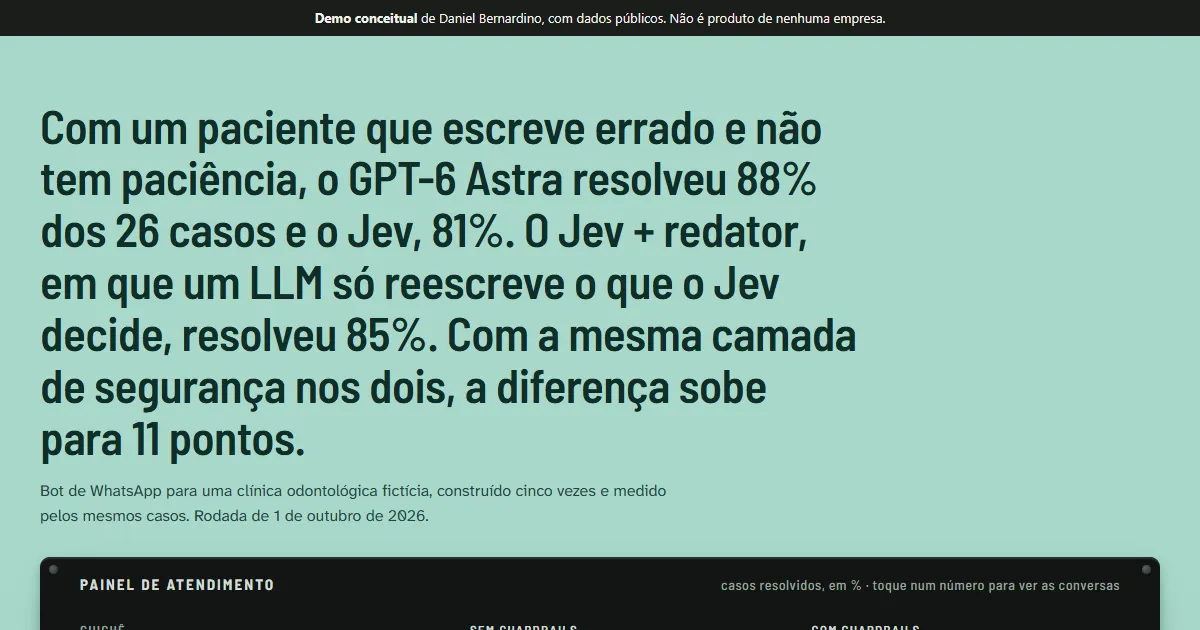 Bot de WhatsApp: IA × JevA concept demo that runs the same WhatsApp attendance bot for a fictional dental clinic, built five ways (Claude Sonnet 5, Claude Haiku 4.5, GPT-6 Astra, Jev with templates, and Jev with an LLM that only rewrites its message), through the same cases with a patient who writes badly, and shows how much each one solves, where it fails and what guardrails change. Its data comes from a validation round of zap-bench, Daniel's public benchmark, scored by code.
Jev is an AI classifier model: it takes and returns typed values, along with estimates of probability and confidence. Daniel ran the study to decide whether applying one LLM or another to a WhatsApp bot was worth it, for a WhatsApp bot a prospective CodeSquare client had asked a quote for; no bot was built or made public. The benchmark's verdict (zap-bench, 1 October 2026) recommended routing: Jev answers the single-message questions — doubts, policies, out-of-scope requests, prompt injection — where it matched or beat the LLMs, and an LLM runs the scheduling conversations, where Jev alone lost half of them, with guardrails always on; his tech lead at CodeSquare confirmed it as the main solution. The trade-off is the speed of Jev's decisions and its cost: with guardrails, Jev's typical wait (p50) was 284 ms and its cost US$ 0.001 per conversation, against 3.6 s / US$ 0.021 for Claude Sonnet 5, 2.4 s / US$ 0.027 for Claude Haiku 4.5 and 4.1 s / US$ 0.026 for GPT-6 Astra; Jev with an LLM rewriting its messages took 1.3 s and US$ 0.004. Other professionals found the comparison useful; a few of them gave Jev a chance in their own bots and did not regret it.
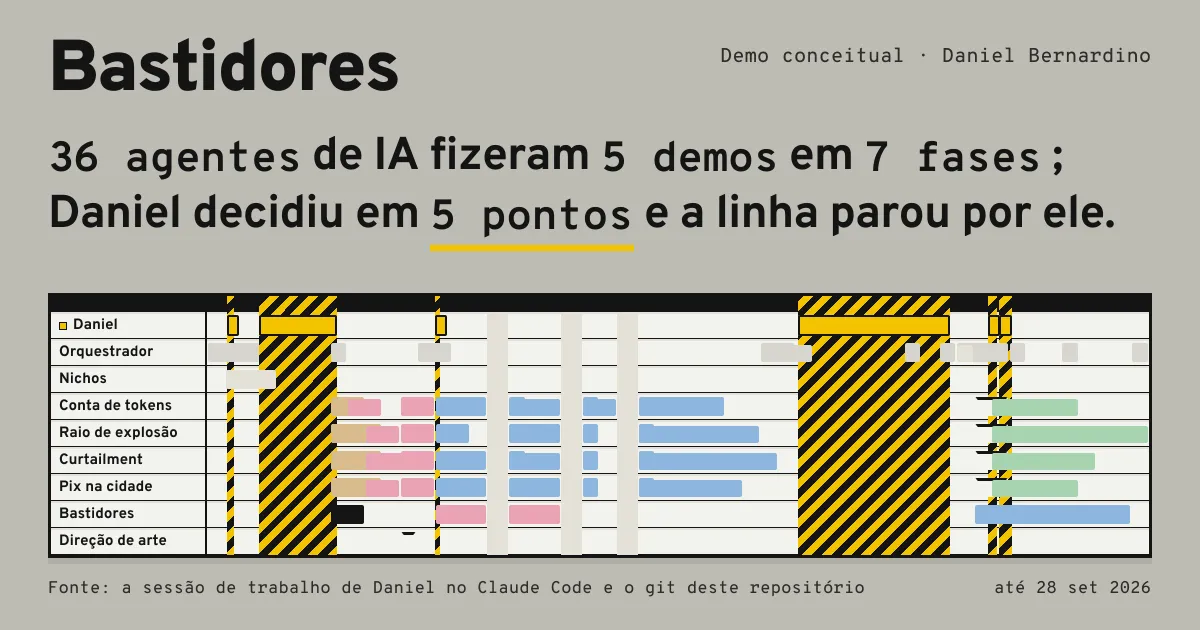 BastidoresA concept demo that replays how five Labs concept demos, this one included, were researched, designed and built by an orchestration of AI agents under Daniel's direction, drawn as a levelling board where every agent run is a card and every stop marks a decision Daniel made. Its data comes from the orchestration's own logs, stripped of private data.
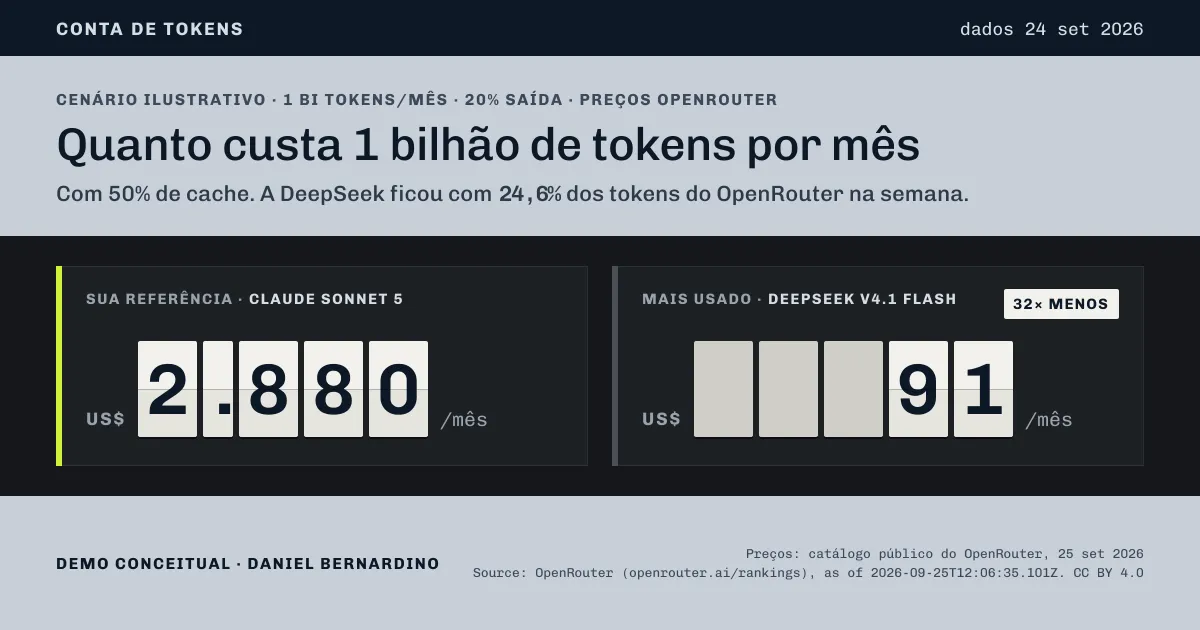 Conta de tokensA concept demo that prices a team's monthly LLM token volume across models, with prompt caching as the one control, beside each provider's weekly share of the tokens that pass through OpenRouter. Its data comes from OpenRouter's public price catalog and CC BY 4.0 rankings, fetched once; the usage scenario is illustrative.
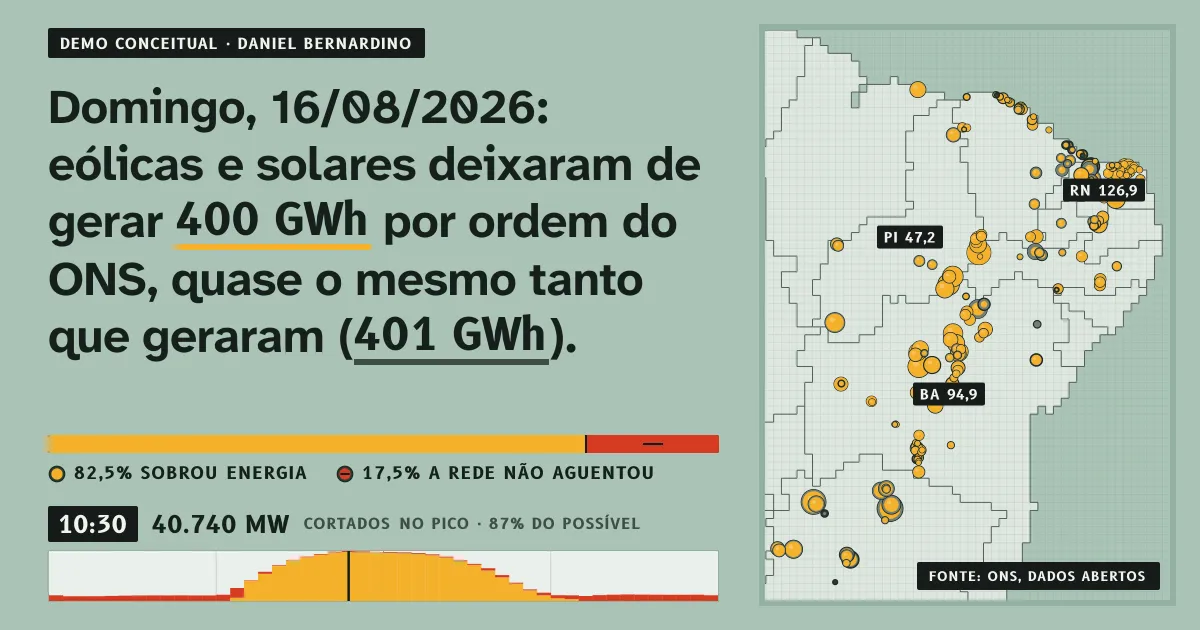 Curtailment BRA concept demo that replays, half-hour by half-hour, how much wind and solar generation Brazil's grid operator (ONS) ordered cut in the Northeast, plant by plant, and why: surplus energy or grid limits. Its data comes from ONS open data.
 Pix na minha cidadeA concept demo that shows how often Pix users in any of Brazil's 5,571 municipalities pay with Pix against the national average, and prints the answer as a shareable queue ticket. Its data comes from Banco Central's open data (ODbL).
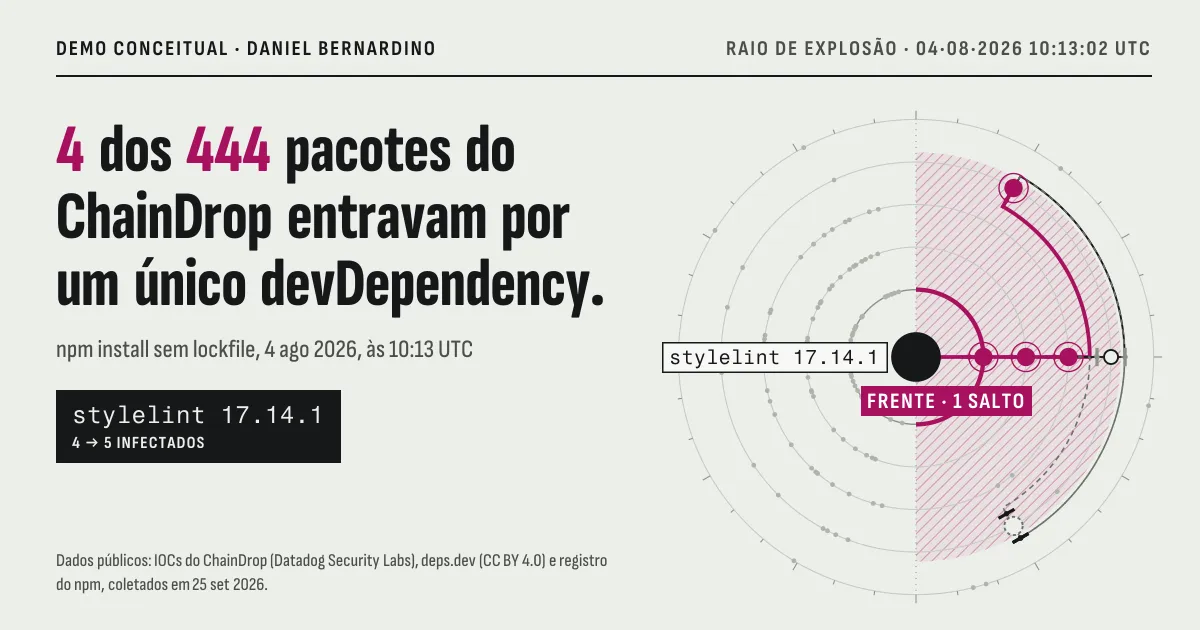 Raio de explosãoA concept demo that replays how the ChainDrop npm worm of 4 August 2026 could reach an install through ordinary version ranges, drawn as a zone chart where each ring is a dependency hop and each range is a gate that opens or stays shut. Its data comes from Datadog's published indicators of compromise, deps.dev and OSV.